




Our youtube channel: Praise and Worship
My testimony
This is my testimony about wonderful things the Lord has done in my life, you can share it with your family or friends who haven’t come to know the Lord. Thank the Lord, glory to Him.
The Rich Man and Lazarus
19 “There was a rich man who was dressed in purple and fine linen and lived in luxury every day. 20 At his gate was laid a beggar named Lazarus, covered with sores 21 and longing to eat what fell from the rich man’s table. Even the dogs came and licked his sores. 22 “The time came when the beggar died and the angels carried him to Abraham’s side. The rich man also died and was buried. 23 In Hades, where he was in torment, he looked up and saw Abraham far away, with Lazarus by his side. 24 So he called to him, ‘Father Abraham, have pity on me and send Lazarus to dip the tip of his finger in water and cool my tongue, because I am in agony in this fire.’ 25 “But Abraham replied, ‘Son, remember that in your lifetime you received your good things, while Lazarus received bad things, but now he is comforted here and you are in agony. 26 And besides all this, between us and you a great chasm has been set in place, so that those who want to go from here to you cannot, nor can anyone cross over from there to us.’ 27 “He answered, ‘Then I beg you, father, send Lazarus to my family, 28 for I have five brothers. Let him warn them, so that they will not also come to this place of torment.’ 29 “Abraham replied, ‘They have Moses and the Prophets; let them listen to them.’ 30 “‘No, father Abraham,’ he said, ‘but if someone from the dead goes to them, they will repent.’ 31 “He said to him, ‘If they do not listen to Moses and the Prophets, they will not be convinced even if someone rises from the dead.’” (Luke 16:19-31)
In this passage, the Lord Jesus tells the parable of the rich man and Lazarus. The rich man lived in luxury, feasting sumptuously every day. Despite his great wealth, he remained indifferent to Lazarus, a beggar who lay at his gate, suffering and hungry, showing neither compassion nor love. In life, Lazarus was poor and covered in sores, longing only for the scraps that fell from the rich man’s table. Though ignored by the world, he was specially remembered by God. After death, Lazarus was carried by angels to Abraham’s side to be comforted, while the rich man found himself in torment in Hades. Abraham pointed out that an impassable chasm exists between the rich man and Lazarus. In the midst of his suffering, the rich man begged for Lazarus to be sent to warn his five brothers, but Abraham replied, “They have Moses and the Prophets; let them listen to them.” When the rich man argued that his brothers would repent if someone were to “rise from the dead,” Abraham explained that if they would not heed the words of Moses and the Prophets, they would not be persuaded even if someone were to return from the dead. This parable serves as a reminder that wealth is temporary; we are called to be faithful stewards of our resources, reaching out to help the poor and those in need around us.
May God bless you and your family!
The Parable of the Unrighteous Steward
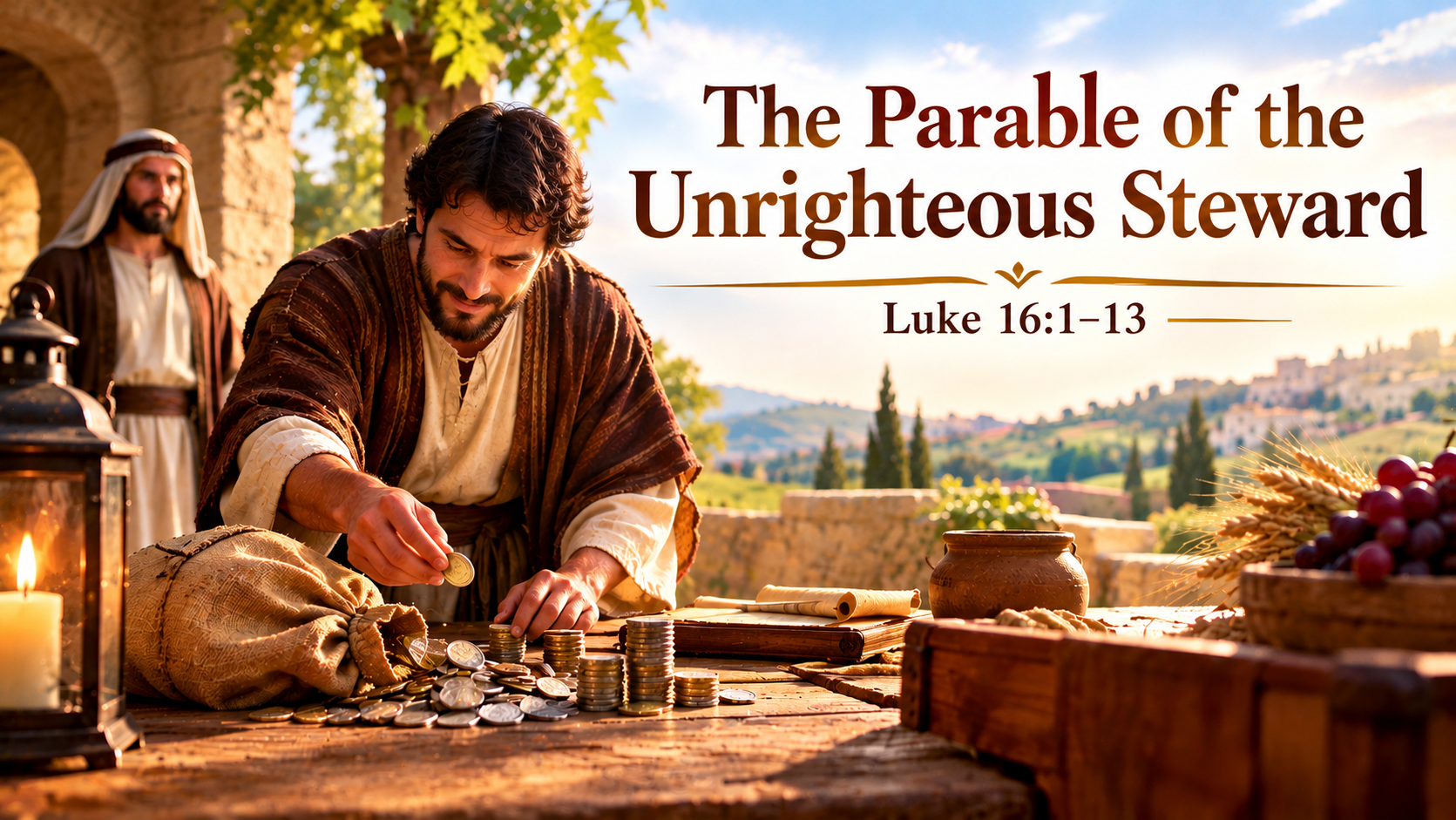 1Jesus told his disciples: “There was a rich man whose manager was accused of wasting his possessions. 2 So he called him in and asked him, ‘What is this I hear about you? Give an account of your management, because you cannot be manager any longer.’ 3 “The manager said to himself, ‘What shall I do now? My master is taking away my job. I’m not strong enough to dig, and I’m ashamed to beg4 I know what I’ll do so that, when I lose my job here, people will welcome me into their houses.’ 5 “So he called in each one of his master’s debtors. He asked the first, ‘How much do you owe my master?’ 6 “‘Nine hundred gallons of olive oil,’ he replied. “The manager told him, ‘Take your bill, sit down quickly, and make it four hundred and fifty.’ 7 “Then he asked the second, ‘And how much do you owe?’ “‘A thousand bushels of wheat,’ he replied. “He told him, ‘Take your bill and make it eight hundred.’ 8 “The master commended the dishonest manager because he had acted shrewdly. For the people of this world are more shrewd in dealing with their own kind than are the people of the light. 9 I tell you, use worldly wealth to gain friends for yourselves, so that when it is gone, you will be welcomed into eternal dwellings. 10 “Whoever can be trusted with very little can also be trusted with much, and whoever is dishonest with very little will also be dishonest with much. 11 So if you have not been trustworthy in handling worldly wealth, who will trust you with true riches? 12 And if you have not been trustworthy with someone else’s property, who will give you property of your own? (Luke 16:1-12)
The Lord Jesus told this parable to His disciples. He commended the unrighteous manager, not for his unrighteousness, but for his wisdom and for preparing for the future. Then the Lord Jesus said, “For the people of this world are more shrewd in dealing with their own kind than are the people of the light.” This means that worldly people are wiser and more diligent in pursuing worldly affairs and temporary gains than believers are in pursuing eternal values.
The Lord Jesus taught His disciples to use worldly wealth to gain eternal friends. Every believer is a steward of God’s property; the resources we possess today are temporary. We must use worldly wealth to prepare for eternity and invest in the eternal realm. We can provide for the poor, donate to the church, and help those in need.
The Lord Jesus continued, “Whoever can be trusted with very little can also be trusted with much” Jesus was speaking about being faithful in the small matter of money so that we will also be faithful in the great matters of the eternity. If we are unfaithful with worldly wealth, God will not entrust true riches to us in the future. Right now, we are stewards of God’s wealth; money belongs to God, and He allows us to manage it. If we are unfaithful with what belongs to God, He will not give us what belongs to us in the future, the eternal heavenly treasures, the things that will truly belong to us as our own eternal inheritance. Therefore, we must seize the opportunities of this present life to invest for eternity and store up treasures in heaven.
May God bless you and your family!
The Parable of the Prodigal Son
11Jesus continued: “There was a man who had two sons. 12 The younger one said to his father, ‘Father, give me my share of the estate.’ So he divided his property between them. 13 “Not long after that, the younger son got together all he had, set off for a distant country and there squandered his wealth in wild living. 14 After he had spent everything, there was a severe famine in that whole country, and he began to be in need. 15 So he went and hired himself out to a citizen of that country, who sent him to his fields to feed pigs. 16 He longed to fill his stomach with the pods that the pigs were eating, but no one gave him anything. 17 “When he came to his senses, he said, ‘How many of my father’s hired servants have food to spare, and here I am starving to death! 18 I will set out and go back to my father and say to him: Father, I have sinned against heaven and against you. 19 I am no longer worthy to be called your son; make me like one of your hired servants.’ 20 So he got up and went to his father. “But while he was still a long way off, his father saw him and was filled with compassion for him; he ran to his son, threw his arms around him and kissed him. 21 “The son said to him, ‘Father, I have sinned against heaven and against you. I am no longer worthy to be called your son.’ 22 “But the father said to his servants, ‘Quick! Bring the best robe and put it on him. Put a ring on his finger and sandals on his feet. 23 Bring the fattened calf and kill it. Let’s have a feast and celebrate. 24 For this son of mine was dead and is alive again; he was lost and is found.’ So they began to celebrate. 25 “Meanwhile, the older son was in the field. When he came near the house, he heard music and dancing. 26 So he called one of the servants and asked him what was going on. 27 ‘Your brother has come,’ he replied, ‘and your father has killed the fattened calf because he has him back safe and sound.’ 28 “The older brother became angry and refused to go in. So his father went out and pleaded with him. 29 But he answered his father, ‘Look! All these years I’ve been slaving for you and never disobeyed your orders. Yet you never gave me even a young goat so I could celebrate with my friends. 30 But when this son of yours who has squandered your property with prostitutes comes home, you kill the fattened calf for him!’ 31 “‘My son,’ the father said, ‘you are always with me, and everything I have is yours. 32 But we had to celebrate and be glad, because this brother of yours was dead and is alive again; he was lost and is found.’” (Luke 15:11–32)
When the Lord Jesus welcomed tax collectors and sinners and ate with them, the Pharisees and teachers of the law began to grumble. In response, the Lord Jesus told three parables: the Parable of the Lost Sheep, the Parable of the Lost Coin, and the Parable of the Prodigal Son. These three parables share a common theme: something is lost, a search takes place, what was lost is found, and there is great rejoicing. All three parables teach that when a sinner repents, there is rejoicing in heaven, and our Heavenly Father rejoices as well. The Lord Jesus used three parables to convey the same message, we can see the importance of the message. In the Parable of the Prodigal Son, the younger son asked his father to give him his share of the inheritance while his father was still alive. He wanted his father’s possessions but not his father himself. He left his father, lived recklessly, and squandered all his money. After he had spent everything, a famine struck the land. He became so desperate that he went to work for someone in that country. He
The Parable of the Lost Coin
8 “Or suppose a woman has ten silver coins and loses one. Doesn’t she light a lamp, sweep the house and search carefully until she finds it? 9 And when she finds it, she calls her friends and neighbors together and says, ‘Rejoice with me; I have found my lost coin.’ 10 In the same way, I tell you, there is rejoicing in the presence of the angels of God over one sinner who repents.” (Luke 15:8-10)
We talked about the parable of the lost sheep last time, and here we have the parable of the lost coin. The two parables have similarities: something is lost, then sought after until found. Here, the woman lights a lamp, sweeps the house, and searches diligently until she finds the coin. Upon finding it, she rejoices and shares the joy with her friends and neighbors. The coin mentioned here, in the original Greek, is a *denarius*—a silver coin roughly equivalent to a day’s wages for an ordinary laborer. This coin was precious to the woman. It represents a sinner; the Lord Jesus says, “There is rejoicing in the presence of the angels of God over one sinner who repents.” When a sinner repents, there is rejoicing before the angels and before the Heavenly Father, the heaven rejoices.
For the Son of Man came to seek and to save the lost. (Luke 19:10)
The Son of Man is the Lord Jesus; He came to seek and save the lost, to save sinners and bring them to repentance and bring them back to Himself.
8 But do not forget this one thing, dear friends: With the Lord a day is like a thousand years, and a thousand years are like a day. 9 The Lord is not slow in keeping his promise, as some understand slowness. Instead he is patient with you, not wanting anyone to perish, but everyone to come to repentance. (2 Peter 3:8–9)
This passage says that God does not desire anyone to perish but He wants everyone to come to repentance and turn to Him; there is rejoicing in heaven over the repentance of every sinner.
May God bless you and your family!
The Parable of the Lost Sheep
3 Then Jesus told them this parable: 4 “Suppose one of you has a hundred sheep and loses one of them. Doesn’t he leave the ninety-nine in the open country and go after the lost sheep until he finds it? 5 And when he finds it, he joyfully puts it on his shoulders 6 and goes home. Then he calls his friends and neighbors together and says, ‘Rejoice with me; I have found my lost sheep.’ 7 I tell you that in the same way there will be more rejoicing in heaven over one sinner who repents than over ninety-nine righteous persons who do not need to repent. (Luke 15:3-7)
Before the Lord Jesus told this parable of the lost sheep, tax collectors and sinners were gathering around to hear Him. The Pharisees and the teachers of the law muttered among themselves, saying, “This man welcomes sinners and eats with them.” Here, the lost sheep represents the tax collectors and sinners, and the shepherd represents the Lord Jesus. Every sheep is precious in His eyes; when one of His one hundred sheep went astray, He left the ninety-nine to search for the lost one until He found it. Upon finding it, He rejoiced greatly and invited friends and neighbors to share in His joy. Then the Lord Jesus said, “There will be more rejoicing in heaven over one sinner who repents than over ninety-nine righteous persons who do not need to repent.” When a sinner repents, there is rejoicing in heaven, the Heavenly Father rejoices, and the angels rejoice as well.
We all, like sheep, have gone astray, each of us has turned to our own way; and the Lord has laid on him the iniquity of us all. (Isaiah 53:6)
Before believing in the Lord, we were all like sheep that had gone astray, each turned to our own way; we lived without God and without the Lord Jesus as our Shepherd. Yet, God and the Lord Jesus sought us out and brought us back. The Lord Jesus came into the world to seek the lost; we hope that more people will believe in Him, turn to Him, and let Him to be their Shepherd, following and trusting in Him.
May God bless you and your family!
The Cost of Being a Disciple
25 Large crowds were traveling with Jesus, and turning to them he said: 26 “If anyone comes to me and does not hate father and mother, wife and children, brothers and sisters—yes, even their own life—such a person cannot be my disciple. 27 And whoever does not carry their cross and follow me cannot be my disciple. 28 “Suppose one of you wants to build a tower. Won’t you first sit down and estimate the cost to see if you have enough money to complete it? 29 For if you lay the foundation and are not able to finish it, everyone who sees it will ridicule you, 30 saying, ‘This person began to build and wasn’t able to finish.’ 31 “Or suppose a king is about to go to war against another king. Won’t he first sit down and consider whether he is able with ten thousand men to oppose the one coming against him with twenty thousand? 32 If he is not able, he will send a delegation while the other is still a long way off and will ask for terms of peace. (Luke 14:25-32)
Large crowds were traveling with the Lord Jesus, because of His teachings, the many signs and wonders He performed, or for other reasons. The Lord said to them: “If anyone comes to me and does not love me more than his father and mother, wife and children, brothers and sisters, yes, even his own life, he cannot be my disciple.” In the original Greek, the word used is “hate”, to “hate” one’s family; the parallel passage in the Gospel of Matthew also speaks of loving the Lord more than anyone else. The Lord Jesus does not literally mean we should “hate” our family, for the Bible teaches us to honor our parents and love one another. Here, the Lord Jesus teaches us to put Him first, to love Him more than our family and even our own lives, otherwise, we cannot be His disciples. We cannot be His disciples unless we deny ourselves and take up our own cross to follow Him. We know of builders who start building a building without properly calculating the cost, only to find themselves unable to finish it; similarly, the Lord Jesus wants us to count the cost of discipleship so that we may persevere to the end. He used another parable regarding warfare, discipleship involves a spiritual battle, we need to count the cost. Being a disciple is not merely about receiving God’s blessings; it requires obeying the Lord, denying ourselves, and putting the Lord first rather than putting our family or ourselves first. We must count the cost and follow the Lord faithfully to the end.
May God bless you and your family!
The Parable of the Great Banquet
15 When one of those at the table with him heard this, he said to Jesus, “Blessed is the one who will eat at the feast in the kingdom of God.” 16 Jesus replied: “A certain man was preparing a great banquet and invited many guests. 17 At the time of the banquet he sent his servant to tell those who had been invited, ‘Come, for everything is now ready.’ 18 “But they all alike began to make excuses. The first said, ‘I have just bought a field, and I must go and see it. Please excuse me.’ 19 “Another said, ‘I have just bought five yoke of oxen, and I’m on my way to try them out. Please excuse me.’ 20 “Still another said, ‘I just got married, so I can’t come.’ 21 “The servant came back and reported this to his master. Then the owner of the house became angry and ordered his servant, ‘Go out quickly into the streets and alleys of the town and bring in the poor, the crippled, the blind and the lame.’ 22 “‘Sir,’ the servant said, ‘what you ordered has been done, but there is still room.’ 23 “Then the master told his servant, ‘Go out to the roads and country lanes and compel them to come in, so that my house will be full. 24 I tell you, not one of those who were invited will get a taste of my banquet.’” (Luke 14:15-24)
Here, the Lord Jesus says that the kingdom of God is like a man hosting a great banquet. The man represents God; He prepares the banquet and issues invitations, and when the time arrives, He sends His servant to summon the guests. However, one by one, they offer excuses for not attending. The first says, “I have bought a field, and I must go and see it.” He surely would have inspected the field before purchasing it; he could see it after the banquet. Another says, “I have bought five yoke of oxen, and I am on my way to try them out.” He could have tried out before buying them, or he could try them out after attending the banquet. Another said, “I have just married a wife, so I cannot go.” He could have gone together with his wife; they were simply making excuses. For people today, these excuses might be studies, work, or family or other reasons for not attending the banquet. The issue is prioritizing one’s studies, work, or family over God’s banquet; they don’t put God first. Because those invited first did not attend, the master told his servant, “Go out quickly into the streets and alleys of the town and bring in the poor, the crippled, the blind, and the lame.” Even after inviting many, there were still room, so the master said to the servant, “Go out to the roads and country lanes and compel them to come in, so that my house will be full. ” God extends His invitation to everyone to dine in the Kingdom of God; those who refuse the invitation will not get a taste of the banquet. Attending God’s banquet is a blessing, and those who do not attend forfeit that blessing. God first called the Israelites and the Gospel was preached to them first; because they did not accept the call, the Gospel was then preached to us Gentiles.
Jesus replied, “Very truly I tell you, no one can see the kingdom of God unless they are born again. (John 3:3) Jesus answered, “Very truly I tell you, no one can enter the kingdom of God unless they are born of water and the Spirit.” (John 3:5)
Here, the Lord Jesus says that without being born again, without being born of water and the Spirit, one cannot see or enter the Kingdom of God. Being born again means believing in the Lord, being baptized, receiving the Holy Spirit, and being born of the Spirit. Hope that more people will accept the invitation to the banquet of God’s Kingdom, believe in the Lord, be baptized, be born again and saved, enter the Kingdom of God, receive eternal life, and receive God’s blessings.
Jesus’ Teachings on Being a Host
12 Then Jesus said to his host, “When you give a luncheon or dinner, do not invite your friends, your brothers or sisters, your relatives, or your rich neighbors; if you do, they may invite you back and so you will be repaid. 13 But when you give a banquet, invite the poor, the crippled, the lame, the blind, 14 and you will be blessed. Although they cannot repay you, you will be repaid at the resurrection of the righteous.” (Luke 14:12-14)
Jesus told the host who invited him: When you host a meal, do not invite your friends, brothers, relatives, or rich neighbors, because they may invite you back and you will be repaid. Invite the poor, the crippled, the lame, and the blind; they cannot repay you, but the Lord will repay you at the resurrection of the righteous. The main idea here is not to receive the repayment from others, then the Lord will repay you in the future!
2 “So when you give to the needy, do not announce it with trumpets, as the hypocrites do in the synagogues and on the streets, to be honored by others. Truly I tell you, they have received their reward in full. 3 But when you give to the needy, do not let your left hand know what your right hand is doing, 4 so that your giving may be in secret. Then your Father, who sees what is done in secret, will reward you. (Matthew 6:2-4)
This passage is about the motivation for doing good is not to to be honored by others, it does not mean that you cannot do good deeds in front of others. It means that the motivation is not to be honored by others. If the motivation is to be honored by others, a reward has already been received; if the motivation is not to be honored by others, the Heavenly Father will reward you.
And if anyone gives even a cup of cold water to one of these little ones who is my disciple, truly I tell you, that person will certainly not lose their reward.” (Matthew 10:42)
Here, Jesus speaks of giving a cup of cold water to the least of his disciples, and even that would be rewarded by the Father.
During the pandemic, we gave a gift to a brother in our church. Later, I had a dream, in the dream our late pastor gave me a gift. At first, I knew what the gift was, but later I didn’t know. The meaning of the dream is that what we do for our brothers and sisters in the church are remembered by the Lord and will be rewarded by the Lord. Thank the Lord!
May God bless you and your family!
Jesus’ Teachings on Being a Guest
7 When he noticed how the guests picked the places of honor at the table, he told them this parable: 8 “When someone invites you to a wedding feast, do not take the place of honor, for a person more distinguished than you may have been invited. 9 If so, the host who invited both of you will come and say to you, ‘Give this person your seat.’ Then, humiliated, you will have to take the least important place. 10 But when you are invited, take the lowest place, so that when your host comes, he will say to you, ‘Friend, move up to a better place.’ Then you will be honored in the presence of all the other guests. 11 For all those who exalt themselves will be humbled, and those who humble themselves will be exalted.” (Luke 14:7-11)
Here we see that the Lord Jesus was invited and saw that the guests picked the places of honor, then He told this parable. He advised people not to sit in the place of honor when invited, but to sit in the lowest place, saying: “For everyone who exalts himself will be humbled, and he who humbles himself will be exalted.” God gives grace to the humble. One who exalts himself will be humbled; one who humbles himself will be exalted.
9 To some who were confident of their own righteousness and looked down on everyone else, Jesus told this parable: 10 “Two men went up to the temple to pray, one a Pharisee and the other a tax collector. 11 The Pharisee stood by himself and prayed: ‘God, I thank you that I am not like other people—robbers, evildoers, adulterers—or even like this tax collector. 12 I fast twice a week and give a tenth of all I get.’ 13 “But the tax collector stood at a distance. He would not even look up to heaven, but beat his breast and said, ‘God, have mercy on me, a sinner.’ 14 “I tell you that this man, rather than the other, went home justified before God. For all those who exalt themselves will be humbled, and those who humble themselves will be exalted.” (Luke 18:9-14)
This passage is the prayer of the Pharisee and the tax collector. The Pharisee, self-righteous and looked down on everyone else, exalted himself but was humbled. The tax collector, knowing that he was a sinner before God, humbled himself and was justified before God. The tax collector humbled himself and was exalted.
May God bless you and your family!
One thing needful- new song
One thing needful
Sit at the Lord’s feet
Listenning to His word
Near to the Lord, near to God
Choose what is better
One thing needful
Choose what is better,
It will not be taken away from you
One thing needful
Choose what is better,
It will not be taken away from you
Thank the Lord, glory to Him.
Enter through the narrow door
22 Then Jesus went through the towns and villages, teaching as he made his way to Jerusalem. 23 Someone asked him, “Lord, are only a few people going to be saved?” He said to them, 24 “Make every effort to enter through the narrow door, because many, I tell you, will try to enter and will not be able to. 25 Once the owner of the house gets up and closes the door, you will stand outside knocking and pleading, ‘Sir, open the door for us.’ “But he will answer, ‘I don’t know you or where you come from.’ 26 “Then you will say, ‘We ate and drank with you, and you taught in our streets.’ 27 “But he will reply, ‘I don’t know you or where you come from. Away from me, all you evildoers!’ 28 “There will be weeping there, and gnashing of teeth, when you see Abraham, Isaac and Jacob and all the prophets in the kingdom of God, but you yourselves thrown out. 29 People will come from east and west and north and south, and will take their places at the feast in the kingdom of God. 30 Indeed there are those who are last who will be first, and first who will be last.” (Luke 13:22-30)
Someone asked the Lord Jesus: “are only a few people going to be saved?” He told the crowd to strive to enter through the narrow door, for many would want to enter but would not be able to. They knew about Jesus, but Jesus said that he didn’t know them; they had no relationship with Him. Abraham, Isaac, Jacob, and the prophets are in God’s kingdom, and many from all the world, from the east, west, south, and north have feast in God’s kingdom, but they could not enter. Jesus said that they were evildoers, lawless people, and lawbreakers.
Everyone who sins breaks the law; in fact, sin is lawlessness. (1 John 3:4)
This says that sin is breaking the law, sin is not obeying God’s will, and sin is lawlessness.
Love does no harm to a neighbor. Therefore love is the fulfillment of the law. (Romans 13:10)
This says that love is the fulfillment of the law; evildoers or lawless people are those without love.
Jesus continued, “But some who are last will be first, and some who are first will be last.” We know that the self-righteous Pharisees and scribes at that time did not believe in Jesus, while tax collectors and sinners repented and turned to him. Therefore, Jesus said, “Truly I tell you, tax collectors and prostitutes will enter the kingdom of God before you.”
For those who exalt themselves will be humbled, and those who humble themselves will be exalted. (Matthew 23:12)
Here Jesus says that the proud, those who exalt themselves will be humbled and the humble, those who humble themselves will be exalted. Hope that more people will believe in the Lord, enter through the narrow door, enter the kingdom of God.
May God bless you and your family!


